

- Market Overview
- Key Benefits
- Service Features
- Sample Table of Contents
Market Overview
Long-term outlook to 2060
Benzene is a fundamental aromatic hydrocarbon and a core building block of the global petrochemical industry. Its defining feature is its stable six-carbon ring structure. At room temperature, benzene appears as a clear, colorless liquid with a sweet, characteristic odor, hence its classification as an aromatic compound. It occurs naturally in crude oil at low concentrations and is commercially manufactured from petroleum-derived feedstocks such as naphtha, gasoil, ethane, propane, butane, and toluene, as well as from coal-based processes. Due to its classification as a known carcinogen, benzene content in gasoline is strictly regulated in major consuming regions, and its use in consumer products such as solvents and sealants has largely been eliminated through reformulation and substitution.
Historically, benzene was primarily recovered as a by-product from coal-based coke production for the steel industry. While this source remains in use today, modern benzene production is dominated by refinery-based naphtha reforming and ethylene steam cracker operations, where benzene is generated as a co-product or by-product. Several other petrochemical processes also contribute to global benzene supply.
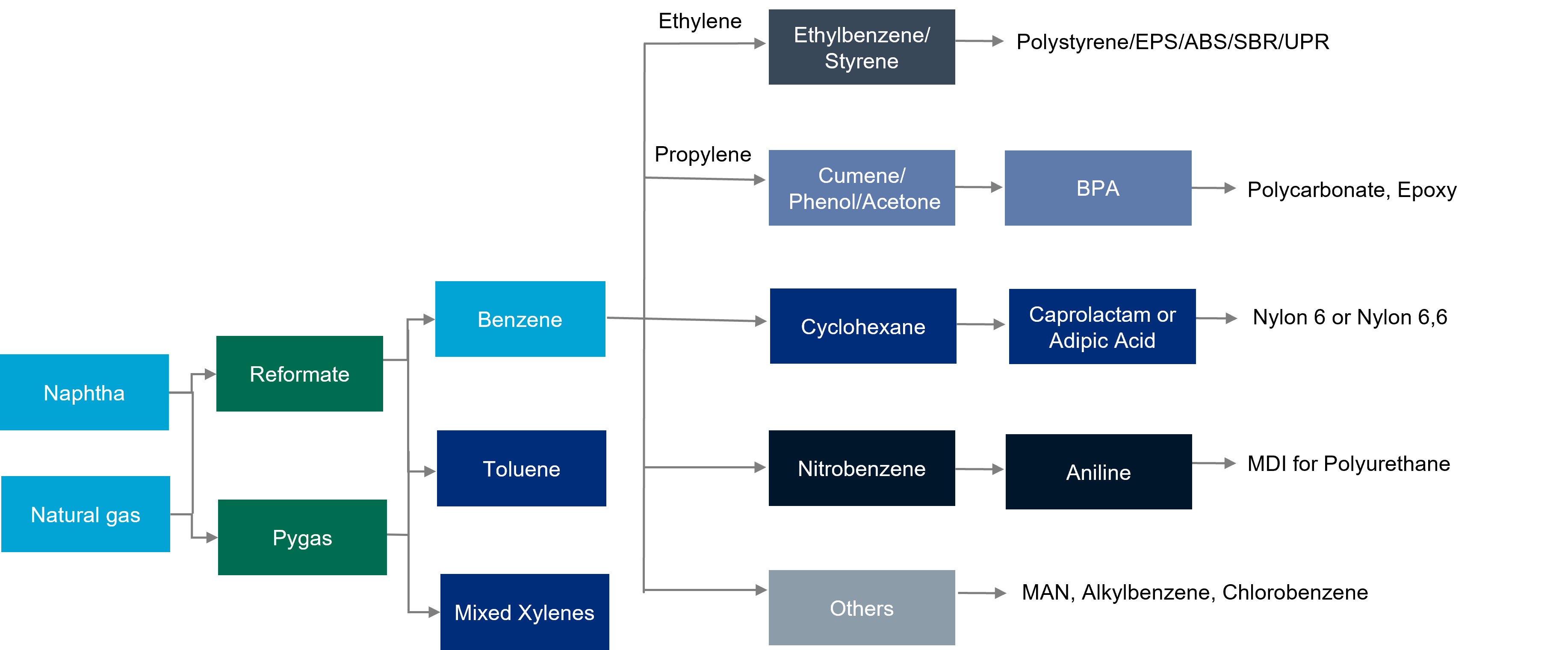
Benzene serves as a vital feedstock for numerous downstream intermediates, including ethylbenzene (EB)/styrene, cumene/phenol, cyclohexane, nitrobenzene/aniline, maleic anhydride, alkylbenzene, chlorobenzene, and various specialty chemicals. These intermediates support the manufacture of a wide range of end-use applications such as food packaging, polyester fibers, carpets and upholstery, synthetic rubbers (including tires), automotive and appliance components, optical and high-clarity plastics (e.g., eyeglasses, bullet-resistant glass), electronic circuit boards, detergents, herbicides, pesticides, and dyes.
Pyrolysis gasoline (pygas) is another critical source of aromatics, produced as a co-product in ethylene (olefins) plants, which often anchor large integrated petrochemical complexes. Generated in steam crackers, pygas production involves numerous unit operations, thermal cracking furnaces, catalytic systems, absorption units, compression, refrigeration, and phase separation. The resulting pygas stream contains benzene, toluene, and mixed xylenes, along with other hydrocarbons.
Pygas can either be blended into gasoline or directed to chemical extraction units where its aromatics are separated for downstream petrochemical production. This flexibility creates a strategic decision point between the energy sector and the chemicals sector, with market conditions, feedstock economics, and regional pricing dictating whether pygas is more valuable as a gasoline component or an aromatics feedstock.
Key Benefits
Long-term outlook to 2060
The World Analysis—Benzene and Pyrolysis Gasoline provides an in-depth assessment of the global benzene and pygas market, providing comprehensive analysis and strategic insights into the key developments shaping long-term supply, demand, trade, and pricing outlooks. This service equips industry participants with the analytical foundation needed to navigate market volatility and anticipate structural shifts across the benzene and pygas value chain.
Subscribers gain access to a full suite of reports, data files, analytical tools, and visualization modules, available online and downloadable from our website, including:
-
A strategic report outlining critical insights and the future trajectory of global and regional benzene markets
-
Online Data Browser access to supply, demand, and capacity databases
-
Continuously updated company/shareholder capacity listings, capacity integration analysis, and rankings of top producers/consumers, including surplus/deficit capacity profiles
-
A comprehensive Data Appendix (Excel) featuring supply/demand and capacity tables, plus a dashboard with standard visualizations for all countries and regions
-
Excel data files with long-range supply/demand graphics and benzene price forecasts through 2060, along with detailed trade grids showing country- and region-level trade flows with 5- and 10-year projections
-
An interactive online dashboard visualizing capacity, integration, supply/demand balances, trade flows, and price, cost, and margin forecasts
-
Explanatory Notes detailing data sources, methodology, assumptions, units, conversion factors, and full World Analysis deliverables
-
Energy and macroeconomic assumptions used in the long-term outlook
-
Price assessment methodology and forecasting framework
This World Analysis provides detailed intelligence on capacities, production, demand, and trade across all major benzene-producing and consuming countries, regions, and global hubs. While robust data collection underpins the historical and forward views, the true value of the service lies in the expert interpretation and market analysis applied by our global team.
Data verification is a central pillar of our approach. Direct engagement with key industry participants ensures that our conclusions reflect real-world market behavior and deliver the most accurate, realistic forward outlook for the global benzene and pygas industry.
Service Features
Long-term outlook to 2060
SUPPLY/DEMAND BALANCES
Frequency: Bi-annual
Format: Online database
Timeframe: 2000 – 2060
Geographical Coverage: Global by country/region
Chemical Products: Benzene, Pyrolysis Gasoline
CAPACITY
Frequency: Updated daily
Format: Online database
Timeframe: 1990 – 2060
Coverage: Nameplate capacity of production units by operating company and shareholder
Chemical Products: Benzene, Alkylbenzene, Aniline, Chlorobenzene, Cumene, Cyclohexane, Ethylbenzene, Maleic Anhydride, Nitrobenzene, Pyrolysis Gasoline
PRICE, COST & MARGIN FORECASTS
Frequency: Quarterly
Format: Online database and Excel
Timeframe: 10-year history and forecasts to 2060
Geographical Coverage: North America (US), Europe & Asia
Chemical Coverage: Benzene
CAPACITY RANKING AND INTEGRATION
Frequency: Updated daily
Format: Online database
Timeframe: 1990 – 2060
Chemical Products: Benzene
TRADE GRIDS
Frequency: Bi-annual
Format: Excel and PIB dashboard
Timeframe: 1 year of history, with 5-year or 10-year forecasts
Geographical Coverage: Global trade flows between partner countries and regions
Chemical Products: Benzene
REPORT WITH STRATEGIC INSIGHTS AND EXECUTIVE OVERVIEW
Frequency: Annual
Format: PDF/HTML
Timeframe: 5-year history, forecast to 2060
Coverage: Regional market summaries
- Production economics/snapshots for major regions/processes
- Production process/technology overview
Chemical Products: Benzene, Pyrolysis Gasoline
ADDITIONAL FEATURES
- Access to our global team of subject matter experts
- Interactive data visualization (PBI dashboard)
- Regional supply/demand graphs (Excel)
- Data appendix with supply/demand, capacity tables and interactive dashboard
- Economy and Energy assumptions
Sample Table of Contents
- Introduction 5
- Executive Overview 6
- Strategic Insights 10
- Introduction 10
- Energy Transition 10
- On-purpose production 12
- Ethylene steam cracker feedstocks 12
- Paraxylene overcapacity and rationalization 12
- Crude-to-chemicals processes 13
- Coal to benzene 13
- Benzene trade 13
- Plastics sustainability 14
- North America 15
- South America 18
- West Europe 21
- Central Europe 25
- CIS & Baltic States 28
- Africa 32
- Middle East 35
- Indian Subcontinent 39
- Mainland China 42
- Other Northeast Asia 45
- Southeast Asia 48
- Production Process Overview 51
- Introduction 51
- Catalytic reforming 51
- Aromatics Extraction Process 53
- Hydrodealkylation 54
- Toluene Disproportionation 54
- Pyrolysis Gasoline Extraction 55
- Aromax Process 56
- Production Process Economics 58
- Explanatory Notes 58
- Benzene Economics - Hydrodealkylation 59
- Benzene Economics - Sulfolane Extraction of BTX 62
- Benzene Economics - Toluene Disproportionation 65
- Price Forecast 68
- Methodology 68
- North America 69
- West Europe 69
- Asia 70
- Price Forecast Tables 71
- Supply/Demand Forecast Methodology 73
Market Coverage
Dyes & Pigments
Flat Glass
Manufacturing
Pharmaceuticals
Soap & Detergents
Related Products
Related Chemicals



Looking for Short Term Analysis ?
Your Success, Our Priority
In a world where markets evolve rapidly, having the right insights is the key differentiator. Partner with us for critical market insights that propel you beyond competition. Your success is not just a goal, it's our commitment.
Contact us today to revolutionize your approach to business strategy with Market Insights!