

Global Defense Strategies and the Chemical Sector
Experts:
- Mariana Santos Moreira, Thought Leadership Director, Dow Jones Energy
As the global geopolitical landscape fractures, defense spending has entered a structurally higher growth cycle. The chemicals and petrochemicals sector has a unique role to play in supporting current and future defense initiatives.
In 2025, NATO European allies and Canada achieved a historic 20% real annual increase in defense spending, with all alliance members exceeding the 2% of GDP target for the first time. Concurrently, global military imports have surged, with European arms imports rising 155% between the 2015–2019 and 2020–2024 periods, according to Dragonfly.
The sector is evolving beyond the volume of capital being deployed; the nature of modern warfare and defense strategies is changing. From a technical perspective, militaries are pivoting from legacy heavy platforms toward autonomous systems, hypersonic weapons, loitering munitions (e.g. unmanned aerial vehicles (UAVs)), and software-defined hardware.
Simultaneously, governments are increasingly focusing on national security sectors and associated supply chains, seeking redundancies, diversifying suppliers, and even reshoring or nearshoring some of the key links. Politically sensitive sectors like defense, health and pharma, and sectors with a significant portion of the workforce, will be prioritized. This effort will redesign global chemical supply chains that are closely related to these industries and national strategies.
For the global petrochemical and chemical commodities sector, higher defense spending also functions as a demand driver. While metals form the skeletons of military platforms, specialized chemicals provide the functionality, e.g. propellants, explosives, high-performance polymers and coatings. The defense industry is a key consumer and R&D driver for specialty chemicals. The global re-armament cycle and defense-linked industrial strategies are creating high-value materials’ demand that spans most chemical value chains.
This report outlines the recent defense industrial strategies adopted by major global powers in 2025 and 2026 and identifies strategic opportunities for global chemical producers.
National Industrial and Defense Strategies: Blurred Boundaries
The boundaries between defense and industrial strategies are blurring.
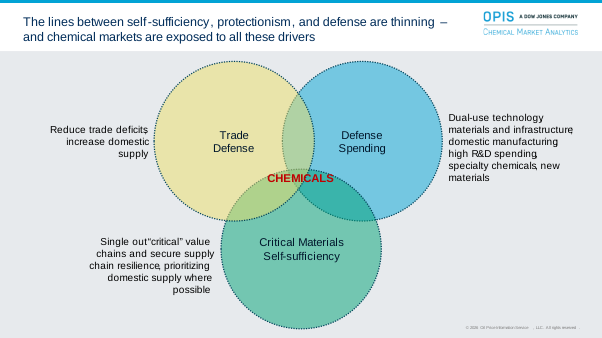
Following severe supply chain shocks in recent years, nations are updating their industrial strategies to emphasize self-sufficiency, domestic capacity building, and “friend-shoring”, viewed also as a matter of national security and trade defense.
A transition from “just-in-time” logistics to “just-in-case” survivalism is driving aggressive stockpiling of critical products, diversifying and/or relocating critical supply chain nodes, and the domestic revitalization of dormant or declining industries. This might mean government support to retain or build domestic chemical, derivatives, or manufacturing assets that would otherwise be unviable economically, especially at times when markets are oversupplied. To support the domestic industry, trade defense strategies such as anti-dumping duties or import tariffs are becoming more widely used. Such self-sufficiency and trade defense trends will inevitably impact chemicals and downstream demand industries at a global scale.
Meanwhile, growing geopolitical tensions and faltering long-term alliances have resulted in a government-driven wave of rearmament and defense spending boosts. Democracies are relying more on military strength and deterrence, rather than diplomatic talks, to achieve their strategic goals. With that in mind, government action is increasingly extending from rising military budgets to policies that combine self-sufficiency, trade, and defense, often with a focus on protecting critical domestic industrial bases and strengthening supply chains. Several new national industrial strategies are addressing defense-related supply chain bottlenecks and ensuring domestic supply of critical materials.
A Shift Towards Diversification, Redundancy and Sovereignty
As trade barriers and geopolitical tensions arose, recently updated national defense strategies have increasingly focused on the foundational layers of the defense supply chain, specifically industrial outputs like chemicals, minerals, and other materials that make advanced weapons manufacturing possible.
The European Union
The European Commission has radically transformed its defense procurement landscape. The legislative centerpiece is the European Defence Industry Programme (EDIP), which dedicates a €1.5 billion work program for 2026–2027. Within EDIP, the Industrial Reinforcement Actions (IRA) framework aims to ramp up manufacturing capacities. The IRA allocates €166.4 million specifically for ramping up the production of energetic components, including propellant powders, explosives, and the necessary raw materials, as well as €275 million for key electronic components, platforms, and end-products.
Crucially, under the European Chemicals Industry Action Plan, the EU officially launched the Critical Chemicals Alliance (CCA) in January 2026. By joining its working groups, industry stakeholders can collaborate with Member States, regional authorities, and civil society to help identify and tackle challenges.
The Critical Chemicals Alliance is tasked with:
-
- Mapping and addressing risks of production capacity closures in the European chemical sector
- Developing criteria to identify critical molecules and production sites essential for the EU’s strategic objectives
- Assisting in the designation of “EU Critical Chemical Sites” to facilitate investments, innovation, and the modernization of critical production capacities
- Addressing global trade challenges, such as supply chain dependencies, unfair competition, and intellectual property rights issues
Ultimately, the CCA aims to safeguard the production of essential molecules, to preserve and modernize strategic production capacities, decarbonize the sector, and protect the European chemical industry from global trade challenges like unfair competition, supply chain dependencies, and intellectual property issues.
Concurrently, the EU is navigating REACH regulatory revisions to introduce “essential use” criteria, ensuring that critical defense chemicals, such as certain per- and polyfluoroalkyl substances (PFAS) used in aerospace seals and semiconductors, remain available despite broader environmental restrictions.
In a parallel effort, the European Chemical Industry Council (CEFIC) and the Aerospace, Security and Defence Industries Association of Europe (ASD) have mapped some 2,500 critical chemicals and metals, also identifying base commodities as vital inputs.

The United States
Following its first National Defense Industrial Strategy in 2024, the United States released a detailed Implementation Plan in late 2025. The US military has recognized its dangerous reliance on overseas chemical precursors for solid rocket motors and artillery. For instance, the Defense Advanced Research Projects Agency (DARPA) has highlighted the US importation of approximately 2.5 million metric tons (mt) of ammonia per year as a critical strategic vulnerability.
The new strategy places emphasis on re-shoring energetics and propellants, as well as specific funding aimed at rebuilding dormant chemical production lines, ensuring the military has the industrial base necessary to surge the production of plastics and explosives during a conflict.
The United Kingdom
Launched in September 2025, the UK’s Defence Industrial Strategy (DIP) explicitly intertwines military capability with broader economic growth. The UK government is under immense pressure from industry groups to treat the chemical supply chain as a critical national security asset to reverse the historical capacity decline of its domestic chemical sector. The UK strategy prioritizes securing supplies of specialized alloys, steel, and high-grade nitrocellulose required to maintain a sovereign ammunition supply.
Japan
Japan’s revised 2025 Economic Security Action Plan uniquely blends military defense with economic security. Updated in May 2025, the plan zeroes in on specialized chemicals essential for semiconductor manufacturing and stealth technologies. To shield its industrial base from supply shocks and industrial espionage, Japan is implementing stringent tracking and safety regulations covering over 150 chemical substances.
South Korea
Under its Defense & Aerospace Power 2030 strategy, South Korea aims to become a “Top 4” global defense exporter. Acknowledging that it relies on imports for 90–95% of its energy and chemical feedstocks, South Korea is overhauling its chemical regulatory framework (K-REACH) to align with NATO standards.
The government has designated 185 critical items, including high-purity chemicals, semiconductor gases, and explosive precursors, with the goal of reducing its import reliance on any single country (not naming but referring to mainland China) to below 50% by 2030. Furthermore, South Korea is mandating the creation of a 100-day strategic reserve for critical industrial and defense chemicals by 2031.
Canada
In February 2026, Canada unveiled its Defence Industrial Strategy (DIS). The federal government has allocated an initial $6.6 billion over five years (starting in 2025–26) specifically to launch the Defence Industrial Strategy and its related initiatives, supported by a massive $81.8 billion in new defense spending outlined in the November 2025 budget to rebuild and rearm the Canadian Armed Forces.
A cornerstone of this policy is a “build, partner, buy” framework that aims to award 70% of defense acquisitions to domestic firms. Additionally, the Canadian Defence Industry Resilience (CDIR) program funds the upstream supply chain to secure raw materials and chemicals. Canada has launched a $1.4 billion investment into domestic ammunition production, explicitly mandating the establishment of a sovereign nitrocellulose production capability by 2029.
According to the official government vision and press releases outlining the strategy, the government projects that implementing the DIS over the next 10 years (by 2035) will result in an investment of over half a trillion dollars. This includes a $290 billion total investment in defence-related infrastructure across Canada by 2035, a significant portion of which is the $35 billion investment specifically allocated to the North, designed to transition Canada from maintaining “seasonal sovereignty” to establishing a permanent, year-round military and industrial presence, which will trigger a decade-long construction boom in the region.
The Arctic investment prioritizes “dual-use” infrastructure that serves both military and civilian needs, including airports and ports, roads, and energy projects (such as hydropower), direct defense infrastructure like refueling bases and ammunition compounds, and housing and IT infrastructure to accommodate the increased year-round presence of troops and civilians.
This effort will drive significant demand for specialized construction and infrastructure chemicals.
Defense-linked Strategic Positioning for Global Chemical Producers
As NATO and allied nations transition toward autonomous warfare, hypersonic systems, and extreme-environment sovereignty, the demand for high-spec polymers, specialized energetics, and resilient coatings will outpace historical procurement cycles.
While individual military applications are often deemed niche, the wide range of products required during global re-armament cycles, combined with a specialty chemical price tag, create important demand drivers across several value chains.
Bespoke Energy and Chemicals Consulting and Advisory Services
Unparalleled Energy & chemical industry consulting expertise
Global chemical and petrochemical producers can position themselves to supply this sector. By aligning production with the specific material needs of modern militaries and securing vulnerable precursor supply chains, producers can embed themselves as indispensable partners in the new global security architecture.
Policy Alignment: Export Controls, Environmental Regulations, Funding
Notably, the defense sector offers lucrative margins, but it is heavily exposed to global trade friction, export controls, and environmental regulations.
Nations are increasingly weaponizing the chemical supply chain. On December 31 2025, mainland China implemented stringent export permit requirements for dual-use chemicals. Even bulk inorganics like soda ash and sodium bicarbonate were targeted, demonstrating a regulatory recognition of their dual-use potential. In parallel, the EU and the US are implementing intense customs scrutiny and anti-dumping measures, initiating multiple trade defense investigations against cheap chemical imports to protect domestic industrial bases.
Meanwhile, governments are unlocking billions in funding for infrastructure that serves both civilian and military purposes. Chemical companies providing soil stabilizers (polyurethane grouts), advanced insulation (extruded polystyrene (XPS)/expandable polystyrene (EPS)), and Arctic-grade construction chemicals should actively target defense infrastructure mega-projects, such as Canada’s Northern Operational Support Hubs or the EU’s military mobility networks.
The tension between environmental policy and military necessity is acute in the EU. Military innovation is actively pivoting toward advanced recycling (solvolysis or pyrolysis), where waste plastics and old aramid fibers are chemically broken down and respun into new high-performance gear, creating a secondary market for chemical recycling technologies. Additionally, the impending bans on PFAS chemicals (forever chemicals) pose a massive threat to the aerospace and defense industries, which rely on PFAS for high-temperature sealants, semiconductor manufacturing, and firefighting foams.
In response, the EU’s REACH revisions are actively carving out “essential use” exemptions for defense applications, acknowledging that these molecules are currently irreplaceable.
Defense ministries are highly motivated to secure domestic supply chains that do not rely on imported fossil fuels or scarce agricultural products (like cotton linters). Chemical producers that can innovate bio-based precursors for energetics, or who develop commercial-scale chemical recycling for advanced polymers (like breaking down aramid fibers), will find demand and significant government R&D funding (such as through the EU’s Horizon Europe or Canada’s BOREALIS initiative).
Capitalize on the Precursor Gap and Critical Mineral Synergies
With the US, EU, and South Korea actively seeking to decouple their defense supply chains from a single major supplier (often mainland China or the US), there is a distinct premium on “friend-shored” precursor chemicals. Producers of baseline organics (toluene, formaldehyde, acetic acid) and inorganics (ammonia, sulfuric acid, nitric acid) should market their capacity as secure, trusted-ally-sourced inputs directly to major defense primes.
The defense sector’s reliance on advanced semiconductors and aerospace alloys directly drives demand for the chemicals used to extract and refine critical minerals. Mining operations for high-priority defense minerals like nickel, cobalt, and rare earth elements require specific chemical agents, primarily xanthates, flocculants, and sulfuric acid for leaching processes.
Demand in Post-Conflict Reconstruction Cycles
Besides the general race to arms derived from rising geopolitical tensions at a global scale, petrochemical and chemical producers can also position themselves to capture post-conflict demand generated by re-armament and reconstruction cycles.
Indeed, we expect that the most significant volumetric pull for chemicals will occur not during active conflict, but during reconstruction. The rebuilding of infrastructure, housing, and civil assets will trigger massive demand waves for construction chemicals, cement additives, steel precursors, and base polymers (polyvinyl chloride (PVC), polyolefins).