

Global Butadiene Market Faces Structural Oversupply and Changing Trade Flows
Experts:
- Bill Hyde, Executive Director & Head of Olefins, Dow Jones Energy
- Mariana Santos Moreira, Thought Leadership Director, Dow Jones Energy
- Remko Koster, Director, Global C4 Olefins, Dow Jones Energy
- Anthony Song, Director, Asia C4 Olefins, Dow Jones Energy
The global butadiene market has faced seven difficult years since 2020. Butadiene demand is concentrated in the durable goods sector, particularly mobility – a key end-use market which was significantly affected by COVID-19. The recovery path has been inconsistent and challenging. Global light vehicle production remains below last decade’s levels, pressuring demand for tires and other rubber parts. Appliance demand also remains soft, affecting ABS demand.
The ongoing conflicts in Ukraine and Iran have not directly impacted global butadiene supply significantly, as very little butadiene is produced in the Middle East and Ukraine lacks production capacity. However, both conflicts are dramatically affecting global energy and petrochemical feedstocks markets. The spike in energy prices in West Europe resulting from the 2022 Russian invasion has materially weakened the European petrochemical industry, leading to multiple announcements of production capacity closures. The 2026 conflict in the Middle East has driven oil and naphtha prices significantly higher, damaging the already weak position of a number of petrochemical producers, particularly in Northeast Asia. On the demand side, affordability issues generally linked to soaring energy prices have delayed the expected recovery in the durable goods market for at least another year, with 2027 also appearing increasingly challenging.
Current market dynamics are not fundamentally changing the long-term butadiene market outlook, but are delaying or masking underlying medium- to long-term trends. Against this backdrop, what are the key factors influencing the market, and what path is it most likely to take?
Butadiene Supply Outlook: Capacity Growth and Feedstock Availability
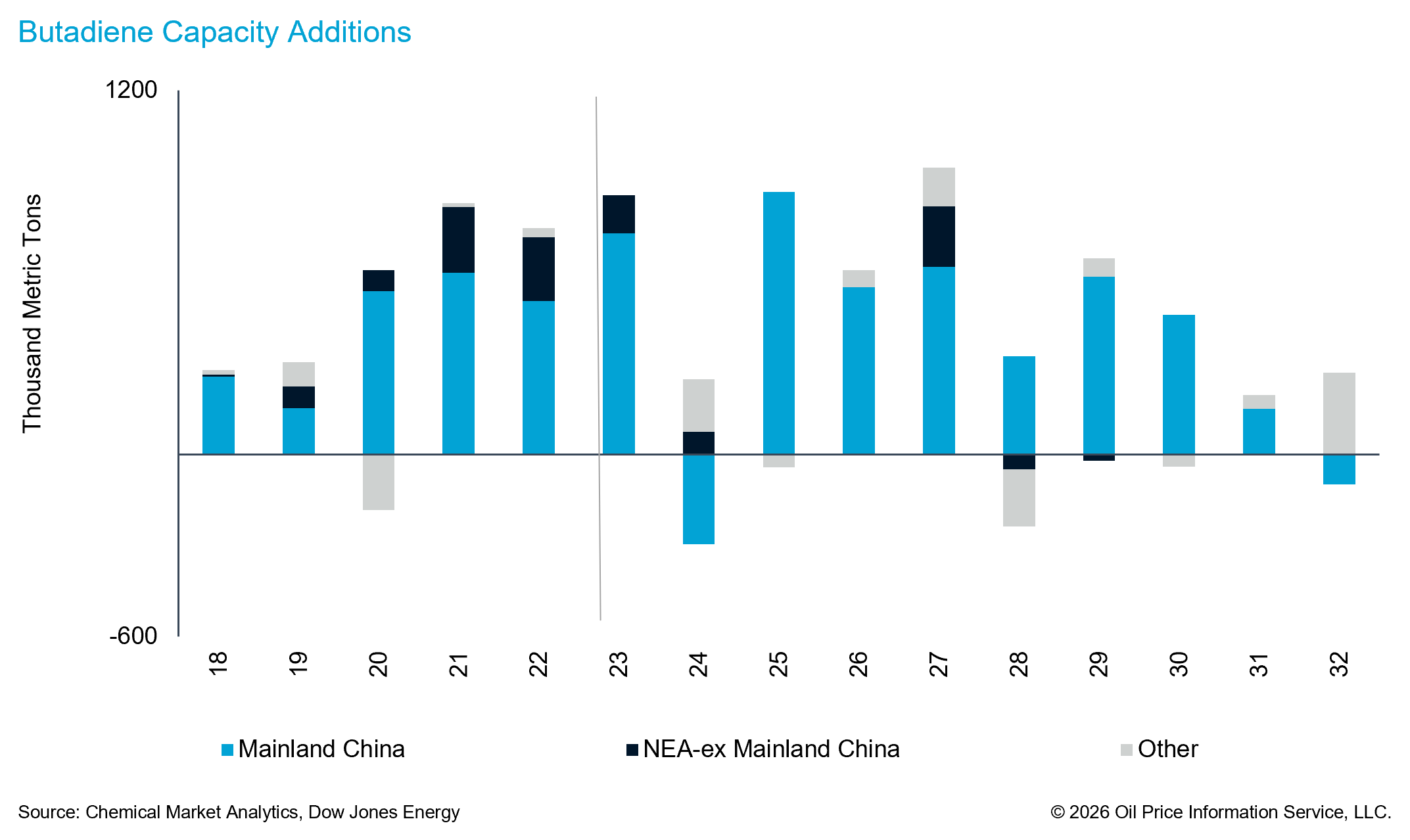
On the supply side, the vast majority of butadiene is produced as a coproduct of ethylene, although it is not sufficient to drive ethylene production strategies. As a result, butadiene supply is largely dependent on ethylene production volumes and feedslates.
However, ethylene demand is forecast to grow at a much faster rate than butadiene demand, and cracker feedslates will likely trend heavier, especially in the 2030s, as the supply of cost-advantaged lighter options becomes limited. Therefore, crude C4 feedstock supply for butadiene production is expected to be plentiful. In fact, some ethylene producers may need to find alternative outlets for their crude C4 production, as there will not be a home for it in the butadiene market. Some regions, primarily West Europe and Northeast Asia outside of mainland China, will see significant ethylene cracker capacity rationalization, which will affect domestic supply.
However, at the global level, crude C4 supply is expected to be long. Since 2019, butadiene capacity additions have significantly outpaced demand growth. By 2030, cumulative surplus capacity additions are expected to reach nearly 4.5 million metric tons. Global butadiene demand is forecast to be approximately 14 million metric tons in 2030, with surplus capacity additions accounting for more than 30% of global demand. This growing imbalance between capacity and consumption is a key factor shaping the butadiene market forecast.
Butadiene Demand Outlook: Growth Driven by China
On the demand side, more than 70% of butadiene is consumed to produce durable goods, with approximately 50% going into mobility. Long-term butadiene demand growth is forecast to be less than 2% per year over the long term. From 2021 to 2026, demand growth averaged around 0.5% per year due to many of the referenced factors.
Global butadiene demand is expected to increase at an above-average rate over the next five years, although regional butadiene demand trends will vary. Approximately 70% of global butadiene demand growth between 2025 and 2035 will be in mainland China. Over the same period, butadiene demand in West Europe is expected to decline. Demand is expected to grow in other key butadiene markets in North America and Northeast Asia outside of mainland China, although it will only be a small fraction of the growth expected in mainland China.
Market Advisory Services – Global C4 Olefins & Elastomers
Short-term outlooks
Global Butadiene Trade Flows: Shifting Regional Balances
Historically, interregional trade has been a significant factor in the global butadiene markets. North America and mainland China have been significant net importers. West Europe has been the key incremental global supplier, although this is changing. The US butadiene balance has shifted from short to long due to significant ethylene capacity additions over the past decade. Mainland China is also shifting to a net export position as a result of massive ethylene cracker investments. Both butadiene supply and demand are expected to contract in West Europe, although volumes should still be available for export. Northeast Asia outside of mainland China is expected to become the largest export destination. This would put West European exports at a disadvantage, as they would be unable to compete with low freight rates from mainland China or the lower crude C4 alternative value in the US.
Regional Butadiene Market Outlook: Oversupply and Capacity Rationalization
From a fundamental perspective, the global butadiene market outlook faces a future of too much supply chasing too little demand. In mainland China, demand growth is expected to be strong, although supply will likely grow at a faster rate, shifting the market from a significant net importer to a net exporter. In North America, low-cost ethylene production has resulted in significantly higher crude C4 production, even though all of the incremental ethylene capacity is based on low butadiene yielding ethane feedstocks. There is limited C4 hydrogenation capacity in the region, and ethane crackers have a relatively low cocrack value for crude C4. As a result, the US is expected to remain a consistent butadiene exporter, primarily to Northeast Asia, until investments are made to consume the crude C4 surplus.
In West Europe, ethylene capacity rationalization has already begun and will likely continue in the future. Butadiene consumption rationalization has also begun since production costs in the region, especially variable costs due to elevated energy prices, have eliminated the export advantage that European butadiene producers and consumers have traditionally enjoyed. Butadiene supply in Northeast Asia outside of mainland China is expected to tighten as ethylene crackers in the region shut down due to their weak cost position.
Butadiene Price Forecast: Naphtha Costs and Regional Price Differences

Northeast Asia is the global butadiene price-setting region. Most of the region’s ethylene production is based on naphtha. Therefore, while it is impossible to determine the actual cost of production for a coproduct, we can consider the value of a coproduct based on its alternative consumption.
In the case of crude C4, this alternative is being recycled to the cracker as feedstock also known as cocracking. So, the crude C4 value can be though ot relative to the naphtha price, as naphtha is what would be the displaced cracker feedstock. Cracking crude C4 generates a lower value to the cracker than virgin naphtha, so its value is a fraction of the naphtha price.
The spread between the butadiene and naphtha prices is one way of thinking about butadiene margins. As we expect the global butadiene markets to be long, the future spread between butadiene and naphtha prices in Asia will be lower than the historical average. The US price will likely be the lowest in the world until investments are made to consume the growing butadiene supply surplus. Butadiene prices in West Europe will likely be toward the higher end of the range.
Join us at the complimentary Acrylontrile & C4 Forum in Seoul on 12 November. Complimentary seats.