

The Evolving Global Soda Ash Landscape
Experts:
- Marguerite Morrin, Executive Director Soda Ash
- Hasan Copur, Director Soda Ash
- Rock Bian, Associate Director China Soda Ash
- Harry Chapman, Senior Analyst Soda Ash
The global soda ash industry is experiencing a significant geographic shift. While Europe and North America are facing plant closures due to elevated energy costs and strict regulations, Chinese companies now represent most of leading global producers.
Global consumption patterns are changing fundamentally, heavily influenced by new, accelerating demand growth stemming from solar glass manufacturing and energy storage applications.
Ultimately, the industry is transitioning toward a landscape defined by natural soda ash reserves and the strategic expansion of Asian manufacturing hubs.
The 2025 Global Market Transition to Oversupply
The global soda ash market is currently navigating a structural reset, characterized by shifting international trade flows, the expanding influence of trade policies such as tariffs, and massive expansions in production capacity.
Despite promising vectors for future demand growth, the market transitioned into an oversupplied state at the beginning of 2025. Following a robust year-over-year global demand increase of 8.5% in 2024, which was driven primarily by mainland China, global soda ash demand experienced a severe deceleration, growing by a mere 1.4% in 2025. This sudden moderation in demand, combined with a sharp and sustained increase in global supply, disrupted the relatively balanced market dynamics of 2024 and entrenched the oversupply conditions that define the current baseline.
Moving forward, global growth is forecast to moderate even further to just 0.5% in 2026, underlining the enduring nature of this surplus environment.
Mainland China Expansion and Overcapacity
Mainland China continues to dominate the global soda ash narrative, driving most capacity additions and fundamentally altering global trade flows. In 2023 and 2024, the country experienced staggering double-digit demand growth, fueled largely by the rapid expansion of solar glass production. However, this momentum stalled significantly, with Chinese demand growing by only 1.2% in 2025. As capacity additions in mainland China have significantly outpaced domestic demand, this overcapacity has actively suppressed domestic prices and forced Chinese producers to adopt an aggressive export strategy to alleviate internal pressures.
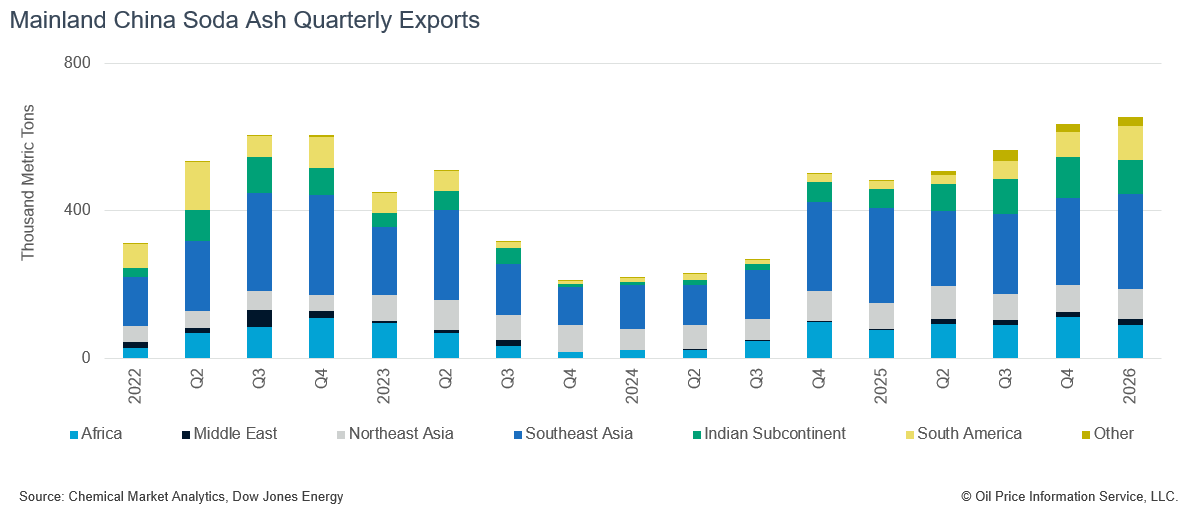
In 2025, mainland China’s soda ash exports exceeded 2 million metric tons (mt), and volumes are projected to approach or even surpass 3 million mt in the near term. Export momentum is accelerating; year-to-date soda ash exports from mainland China are currently at their highest levels on record. In April 2026 alone, exports surged by 41% year-over-year, totaling 925,000 mt. This surge was supported by higher global bunker fuel costs tied to the Middle East conflict, which paradoxically improved the cost competitiveness of Chinese soda ash in nearby Asian export markets. Furthermore, mainland China’s massive surplus volumes are increasingly penetrating distant regions such as South America (specifically Argentina) which historically had not been regular destinations for Chinese material.
Despite this development, mainland China’s capacity continues to grow. Although several Hou-process soda ash plants have remained idle due to extended maintenance or technology upgrades, natural soda ash capacity in the region continues to expand. Taking all closures and additions into account, mainland China will see a definitive net increase in effective soda ash capacity in 2026. Looking beyond the short term, mainland China has highly ambitious projects in the pipeline, including another massive natural soda ash plant scheduled for Inner Mongolia in mid-2028, alongside ongoing efforts to explore further natural soda ash reserves.
While Chinese capacity surges, traditional Western production centers are experiencing severe contractions. In 2025, approximately 1 million mt of soda ash capacity was permanently closed in Europe, precipitated by a toxic combination of elevated regional energy costs, tightening EU regulations on carbon emissions, and fierce competition from lower-cost non-European producers, particularly those in Türkiye. This contraction trend continued into early 2026, with Solvay announcing further capacity reductions at its facility in Spain.
Simultaneously in the US, Searles Valley Minerals (SVM), a company owned by the Indian conglomerate Nirma, officially mothballed its natural soda ash operation in California in February 2026. This landmark event marked the first closure of a US soda ash plant in more than two decades, a decision the company directly attributed to high energy expenses, California’s extensive regulatory requirements, and mounting competition from low-cost seaborne exports.
Despite these significant closures in the EU and the US, global net soda ash capacity is still expected to increase by nearly 2 million mt in 2026, with the massive new projects in mainland China more than offsetting the permanent Western closures and temporary Chinese shutdowns. The industry is also witnessing new capacity development plans emerging in countries that have not traditionally been producers, including Indonesia, Egypt, and Kazakhstan.
Global Producer Ranking Shifts
Continuous capacity additions, especially in mainland China, outpacing global demand growth have triggered a historic reshaping of the industry’s corporate hierarchy.
For approximately a century, the European chemical company Solvay maintained its position as the world’s largest soda ash producer. This dominance ended in 2025 when WE Soda acquired Genesis Alkali in the United States, temporarily elevating WE Soda to the top position. However, this ranking shifted once again following the massive expansion of the Chinese firm Berun, in Inner Mongolia.
Today, Berun stands as the single largest soda ash producer in the world, uniquely holding all its massive capacity at a single site. This milestone marks the first time in the history of the soda ash industry that a Chinese company has held the number one global position. Reflecting this monumental shift, six of the top ten soda ash producers globally are now based in mainland China.
End-Use Demand Evolution: Glass and the Energy Transition
Understanding the future of the market requires an analysis of the rapidly evolving end-use sectors. In 2026, total glass production is projected to account for 56% of global soda ash consumption. Within this space, flat glass remains the largest single end-use sector.
Global flat glass production contracted by an estimated 1% in 2025, and only a marginal recovery of less than 1% growth is forecast for 2026. Moving forward, medium- to long-term demand for flat glass will likely depend heavily on developing regions, supported by sustained construction and automotive applications.
In 2026, total glass production is projected to account for 56% of global soda ash consumption. Within this space, flat glass remains the largest single end-use sector.
The automotive sector provides a strong demand signal; global light vehicle production increased by 3% in 2025 to reach 92 million units, while electric vehicle (EV) production skyrocketed by 21%, capturing a 28% share of total automotive output. Rising fuel prices and acute energy security concerns linked to the Middle East conflict are expected to further accelerate the global adoption of EVs. In 2026, the combined global production share of electric and hybrid vehicles is officially projected to surpass that of traditional internal combustion engine vehicles for the first time, bolstering demand for both automotive flat glass and lithium.
Conversely, the container glass sector, the second-largest end-use category for soda ash, remains under severe and sustained pressure. Supported historically by the food and beverage industries, this sector has faced massive challenges due to ongoing pressures on consumer spending and a fundamental shift in consumer preferences toward low- and no-alcohol beverages. Consequently, between 2023 and 2025, nearly 3 million mt metric tons of container glass capacity was forced to shut down across the US and Europe, with a further 1 million mt projected to close before the end of 2026. Although production declined slightly in 2025, wine-related glass volumes remained somewhat resilient, and global container glass production is tentatively forecast to increase by 1% year-over-year in 2026. While this suggests the beginning of a recovery, the industry remains structurally fragile in the near term.
The most dynamic growth driver for global soda ash demand is undoubtedly solar glass, which is expected to be the fastest-growing glass segment between 2026 and 2030. Photovoltaic (PV) solar panel installations maintained extraordinary growth globally in 2025, yet this boom did not translate into higher domestic soda ash demand within mainland China. This disconnect was attributed to substantial overcapacity in the Chinese PV and solar glass sectors, which allowed rising domestic PV installations to be met largely through the depletion of existing inventories, causing Chinese solar glass production to decline. This inventory drawdown trend is expected to persist into 2026; Chinese solar glass production is forecast to fall again despite a net increase in PV installations. Given mainland China’s dominant position, this domestic contraction is expected to weigh heavily on total global output figures. However, outside of mainland China, the solar glass sector remains incredibly robust, exhibiting double-digit production growth in 2025 with further double-digit expansion forecast for 2026.
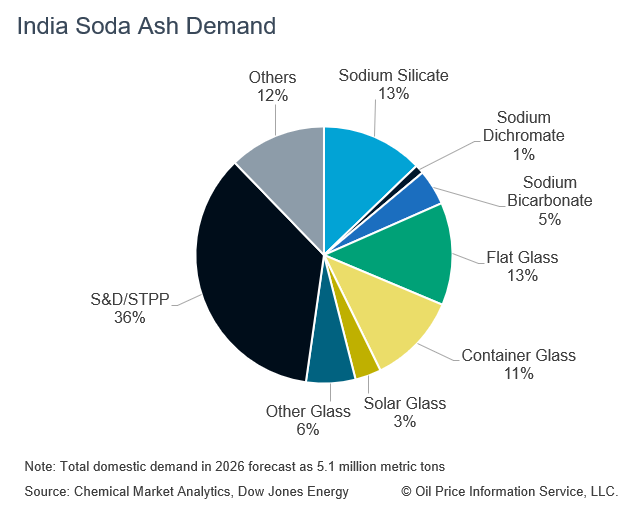
In the Indian subcontinent, India’s soda ash demand is expected to outpace the global average in 2026, driven heavily by new solar, flat, and container glass capacity additions. The solar sector is a key driver, as India is now the third-largest country globally in terms of installed solar power capacity and aggressively protects its domestic solar glass industry with anti-dumping duties on imports from mainland China, Vietnam, and Malaysia.
Alongside solar applications, lithium processing continues to drive critical new soda ash demand. While it currently represents a very small share of total global demand, lithium carbonate is projected to be the fastest-growing end-use application for soda ash between 2026 and 2030. Double-digit growth was recorded in 2025 and is expected to continue through 2026, primarily concentrated in mainland China. This explosion in lithium demand is driven by rapidly expanding EV manufacturing and the exponential growth of utility-scale Battery Energy Storage Systems (BESS), which currently represent the fastest-growing battery segment globally. Within this space, demand for lithium carbonate, mainly utilized in lithium iron phosphate (LFP) batteries, is growing at a faster rate than demand for the lithium hydroxide used in high-nickel battery chemistries.
Mainland China currently dominates global lithium refining, though its market share is expected to gradually decline as the phased removal of mainland China’s VAT export rebates on battery products incentivizes the expansion of battery manufacturing into other global regions.
Regional Trade Flows
Global trade is a fundamental component of the soda ash industry, with approximately 25% of all global output traded internationally. 2026 has been marked by supply chain disruptions linked to the escalation of the Middle East conflict. The Suez Canal and Red Sea trade routes are currently experiencing severe disruptions. Despite these disruptions, the global market is expected to remain adequately supplied.
Market Advisory Service – Global Soda Ash
Stay ahead with reliable price forecasts, supply/demand data, and strategic industry analysis
The Gulf accounts for approximately 2% of global soda ash demand. Outside of Iran, the only soda ash production capacity in the Gulf is in Saudi Arabia. Iran’s capacity exceeds domestic demand, enabling the country to act as a net exporter. However, little to no soda ash has reportedly been exported from Iran since the end of February. Notably, in 2025, nearly one quarter of Turkish soda ash exports were shipped to markets east of Türkiye, meaning a significant portion of this trade relied on the Suez Canal route.
In 2025, the United States retained its undisputed position as the world’s largest soda ash exporter, accounting for nearly 40% of all global trade volumes. Although total US exports dipped slightly to 6.7 million mt last year, export volumes are expected to trend upward over the coming years as new domestic capacity is commissioned. Crucially, the US benefits from a highly insulated and favorable energy environment. Since March 2026, the US gas market has been largely unaffected by Middle Eastern supply disruptions. This dynamic has caused US cash costs to decline compared to 2025. However, the primary market for US producers is exports, where domestic rail and international sea freight costs are increasing.
Relatively stable US gas prices could have created a cost divergence between US producers and their typically higher-cost European Solvay and Chinese Hou-process counterparts. However, Hou-based producers in mainland China have also seen improved economics due to the closure of the Strait of Hormuz, which materialized two-fold: (1) coal prices in mainland China have remained relatively stable this year, and (2) ammonium chloride prices have increased due to Middle Eastern fertilizer export curtailments and the resulting global shortage.
Southeast Asia, excluding mainland China and India, produces minimal soda ash, making it the largest importing region in the world. In 2025, regional imports surged to a record 4.4 million mt, easily surpassing the previous high set in 2022. Indonesia was the primary driver of this demand spike, seeing import volumes increase by 25% year-over-year, alongside an 8% increase in Malaysia. This massive influx of imports is directly tied to the construction of enormous new flat and solar glass capacities across Southeast Asia. Regional flat and solar glass producers are strategically positioned to benefit from mainland China’s elimination of VAT rebates on glass exports. However, near-term regional demand growth may be temporarily constrained by the broader economic fallout of the Middle East conflict. Local production is also being developed to mitigate this significant reliance on imports, including PT Pupuk’s 300,000 metric ton Hou-based plant in Indonesia, scheduled to start up in late 2027 or early 2028.
Despite a strong demand outlook, Indian soda ash producers face severe domestic supply and cost pressures. Coal prices are expected to remain elevated until early 2027, and vital limestone imports from the Middle East, which historically accounted for over 95% of total Indian imports, have been severely disrupted. Consequently, Indian producers are forced to rely on lower-quality local limestone, which requires higher usage rates and has spiked in price due to overwhelming local demand. Furthermore, India expects a sharp decline in soda ash imports from Iran and Russia this year. However, total imports are projected to remain stable at over 1 million mt in 2026, as the lost volumes are entirely offset by aggressive increases in imports from mainland China.
Meanwhile, Bangladesh is entirely reliant on imports and has dramatically shifted its supply chain over the past year. Imports from traditional suppliers—India and Pakistan—saw a reciprocal decline, with Indian market share in Bangladesh dropping from 42% in 2024 to just 20% in 2025 and early 2026. This coincided with mainland China aggressively capturing the market, increasing its share of Bangladeshi imports to approximately 55% in 2025.
Strategic Outlook and Future Trajectory
As key industry stakeholders prepare to convene at the upcoming World Soda Ash Conference in Valencia, Spain, the market sits at a critical juncture.
The global soda ash landscape is undeniably defined by a structural surplus, driven largely by mainland China’s relentless capacity additions which have more than offset permanent closures in Europe and the United States. While the short- to medium-term market is expected to remain heavily oversupplied and constrained by sluggish GDP growth and elevated production and freight costs, underlying demand fundamentals remain remarkably robust.
The aggressive global expansion of the energy transition, characterized by exponential growth in solar photovoltaic manufacturing and lithium carbonate battery production for EVs and energy storage, ensures that critical new demand sectors will continue to thrive. In this context, the ongoing geopolitical conflict in the Middle East may paradoxically serve as a catalyst for future growth, potentially accelerating the global transition toward these new energy sectors as nations increasingly prioritize their own domestic energy security.

**Originally written in July 2026.