Global Ammonia and Urea Fortunes in Flux Amid Search for Equilibrium
Expert: Michael Samueli, Executive Director Ammonia-Urea
Global ammonia and urea supply was disrupted almost immediately after US and Israeli strikes on Iran on 28 February initiated the latest Middle East conflict, leading to Tehran effectively blocking the Strait of Hormuz. Prices rose almost overnight as around one-third of global seaborne international supply was either taken offline or put at risk.
The price increases culminated around mid-April when an Indian urea purchasing tender resulted in 2.5 million metric tons (mt) being secured at $935 per mt cost and freight (CFR) for the West Coast, with the price for the East Coast higher by $24 per mt. These levels were not far from the historic highs reached in 2021 to 2022. However, unlike in much of 2021 to 2022, the bullish sentiment on the back of the supply shortfalls was not sustained.
Background, Fundamentals, and Significance
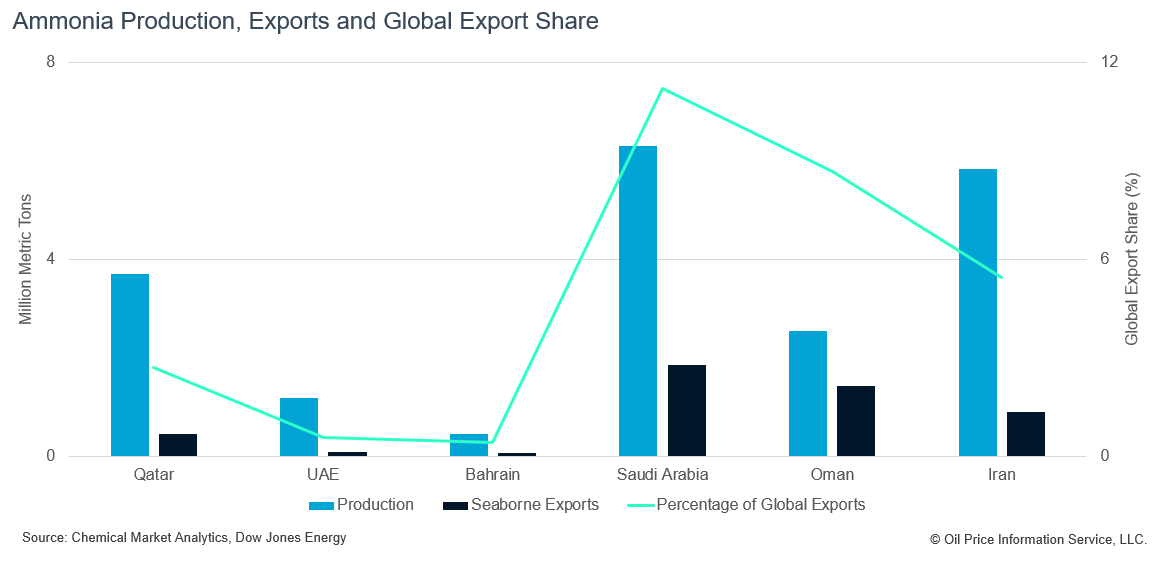
Urea is the single largest downstream application of ammonia and accounts for around 60% of overall demand. Urea is far more liquid than ammonia, with around 30% of total global production traded internationally while for ammonia this does not exceed 9%.
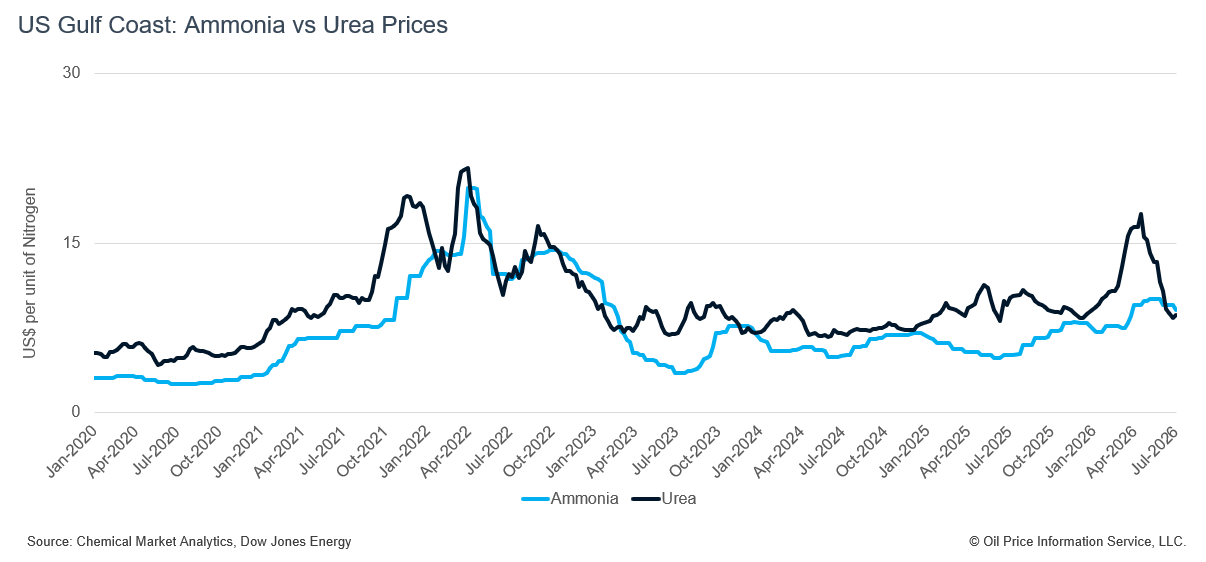
There is strong price correlation between the two products and the liquid urea markets are often a precursor to ammonia’s fortunes, particularly during periods of turbulence, although at times with a significant delay of several weeks.
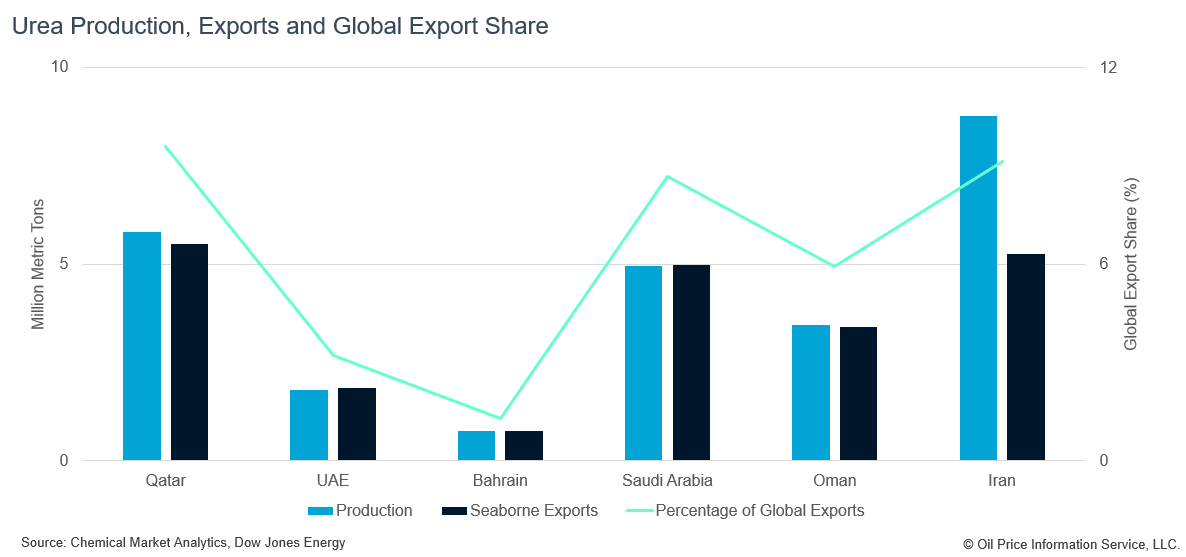
Total ammonia and urea production per year is 190–200 million mt for each, with the Middle East accounting for around 29% of total global seaborne ammonia trade and 38% of total urea trade. The bulk of globally produced ammonia, including in the Middle East, is captive within the production sites and used in-house as a raw material for further downstream output of other products, including urea.
Spike, Flatline, and Nosedive
During the initial price surge from March onward, the Tampa ammonia benchmark price gained $210 per mt within less than six weeks to reach $825 per mt, CFR. The initial round of business, along with the loss of Middle Eastern supply, placed producers and suppliers in a comfortable position. When demand waned as buyers hesitated because of the higher prices toward the end of the spring fertilizer application season, producers were confident that they would be able to outwait buyers. However, after a period of price stagnation, sentiment became firmly bearish and within weeks prices had begun to decrease.
The extent of the price decline became clear when India issued, in early June, its second urea purchasing tender since the beginning of the Middle East conflict. This resulted in a purchase at $445 per mt, CFR, less than half the cost of the previous tender, in mid-April, which concluded at $935 per mt, CFR.
More recently, the July Tampa contract price for ammonia was settled at $665 per mt, CFR, down by $110 per mt month on month. The latest level is just $50 per mt above pre-conflict prices.
Déjà Vu and Causes
The sharp price drop was largely unanticipated by the markets, particularly the extent and speed of the decline. The reversal in fortunes and overall lack of demand was caused by multiple factors but, notably, occurred despite Middle Eastern volumes remaining out of the markets.
Market Advisory Service – Global Ammonia Analysis
Stay ahead with reliable price forecasts, supply/demand data, and strategic industry analysis
Grains: Unlike in 2022, crop prices did not surge in tandem with farmer feedstock fertilizer prices, including ammonia and urea. US December corn contract prices barely reacted and remained comfortably below $5 per bushel. In 2022, corn prices peaked at just above $8 per bushel and remained consistently above $6 per bushel. Consequently, farmers did not have downstream incentives to accept the rapidly rising prices.
European Gas: Dutch Title Transfer Facility (TTF) gas prices made significant gains from around €30 per MWh to around €50 per MWh following the onset of the Middle East conflict. Although this increased production costs for European producers, who were already facing the highest feedstock prices globally, the costs were manageable and did not put European output under threat as they had done in 2021 to 2023. The stability in European supply played a significant deflationary role by contributing to a sizeable portion of regional demand being met.
Seasonality: By mid-to-late April, the bulk of seasonal Northern Hemisphere (Europe, the United States, mainland China, etc.) demand was ending. Any new purchases would be for the 2027 spring season, giving buyers across the supply chain plenty of time to secure the required volumes.
In addition, sizeable seasonal demand from the Southern Hemisphere, particularly Brazil, had yet to begin, with this usually not occurring before late August at the earliest. Only India remained fairly active, but this was not sufficient to sustain the markets.
Erosion: As prices of raw materials such as ammonia and sulfur increased, downstream producers found it increasingly difficult to pass these costs on to buyers. By mid-to-late April, it was clear that a significant portion of downstream production output was being curtailed. This was particularly noticeable for two of the largest phosphate producers in the world, which were reported to have cut output by 50%. This in turn reduced the need for raw materials, including ammonia.
Over the following weeks, demand erosion across the value chain became apparent and at first this led to a balancing of supply and demand. However, the sharp downturn in demand soon resulted in downward pressure on prices as demand erosion rapidly began to outpace the global supply shortfall.
Mainland China: Arguably the most significant event of the year since the onset of the Middle East conflict was mainland China’s return to the urea export markets in late May. For now, the lack of firm demand and the decline in prices have kept these volumes at bay, although their mere availability is of concern in the market. State-sanctioned limitations on minimum prices and the final destinations of exports have also complicated business. State authorities strictly control mainland China’s urea exports through a variety of measures with the aim of avoiding price volatility domestically and ensuring domestic supplies for the local agricultural sector.
In the last few years, once the April-to-June domestic season was over, export allocations were granted in the form of quotas. This year’s export quotas of at least around 2 million mt of urea over the summer months largely compensated for the lack of Middle Eastern volumes. These quotas, if unused, will most likely be rolled over into later months. They also came at seasonally the weakest demand period of the year for fertilizers and almost immediately led to a sizeable depression in values.
Middle East: Throughout the first few months of the latest Middle East conflict there were signs that the conflict might end soon. This led to anticipation of the Strait of Hormuz reopening and of Middle Eastern product returning to global markets. The resumption of supply implied the return of prices to pre-conflict levels. Thus, buyers across the supply chain were cautious about taking length, especially for forward months.
Beyond the above factors, the frequency of major geopolitical developments since 2021 to 2022 has somewhat dampened the extent of the ammonia market’s reaction to these events. In 2021 to 2022, after the onset of the Russia-Ukraine war, traders reacted with a flurry of activity and position taking, but in 2026 they have sought to sell on existing positions before building further length. This limited activity has led to more subdued demand compared with previous market supply shocks of recent years.
Ammonia and urea market fortunes are closely interlinked beyond the very short term. Downstream urea’s long-term premium over ammonia in the US Gulf markets has been $2.35 per unit of nitrogen. At the beginning of July, urea was trading at a discount to ammonia.
The Summer and Beyond
The situation in the Middle East continues to be precarious with the outlook for the conflict almost impossible to forecast and yet deterministic for the markets. However, buyers have concluded the 2026 season for ammonia and urea purchases in the Northern Hemisphere. In the south, firm demand is unlikely to emerge before late August at the earliest. Thus, the demand outlook for the near term is not positive.
The demand outlook changes from September to October. Brazilian and wider Latin American demand will pick up and culminate toward the end of the year. At the same time, Indian enquiries should be ongoing for major volumes, although the degree of interest will likely be informed by the extent of domestic production and seasonal rainfall. Forecasts from July are for below multiyear average precipitation in the coming weeks. Less rain usually leads to dampened consumption in India.
Beyond these markets, soft enquiries from the Northern Hemisphere should start to pick up from September to October as importers begin building inventory for the 2027 spring season. In the United States, there is usually a modest flurry of demand ahead of the cold weather leading to a sharp decline in barge movements along the Mississippi River, the key transportation artery for imported product. ‘River close’ usually occurs in November, with the timing dictated by the weather.
Similar to the United States, European demand should also pick up in the fourth quarter. Typically, importers look to build some inventory after the harvest has been mostly sold, which clears warehousing space for fertilizer purchases.
On the supply side, mainland China’s export quota allocations heavily influence the urea and, by extension, ammonia markets. Whether product from mainland China is available in the fourth quarter or not will be crucial in determining market values. In recent years, government officials have effectively blocked exports of urea in the fourth to the first quarter and beyond to support domestic buyers and end users. A similar development is likely with the final export quotas expiring in September. However, total urea production in 2026 has been significantly higher to date and if this continues the chance of additional export quotas later in the year will increase. In addition to mainland China’s heightened urea production, a potential sudden return of Middle Eastern supply to the export markets which would put downward pressure on prices is further reducing immediate-term buyer appetite.
Ammonia and urea market fortunes are closely interlinked beyond the very short term. Downstream urea’s long-term premium over ammonia in the US Gulf markets has been $2.35 per unit of nitrogen. At the beginning of July, urea was trading at a discount to ammonia.
The current spread between ammonia and urea appears unsustainable. If the market remains bearish, ammonia values are likely to be too high relative to urea and if the market turns bullish, urea values are likely to be considered too low relative to ammonia. Corresponding price movements for both products are anticipated and highly likely over the coming weeks and months as values for both markets recalibrate.
As of early-to-mid-July, ammonia and urea markets were bearish. However, a sudden major escalation of the Middle East conflict could upend this sentiment and outlook. Buyers may consider long-term supply security to be at risk and opt to secure volumes for next season as soon as possible. A significant spike in demand will exacerbate and expose the strategic shortfall in global supply because of the Middle East conflict and this, in turn, will affect prices.
On balance, however, the summer months are likely to be challenging for suppliers and prices will most probably recalibrate at the lower levels. All major buyers have time on their side and can pace purchases to not exceed supply until at least October and possibly November, with most product required for late 2026 or even 2027. The current carry price risk is likely to be too significant for most buyers. Producers’ fortunes are unlikely to change until late August, early September onward as significant Brazilian and Indian demand emerges.
**Originally written in July 2026.